

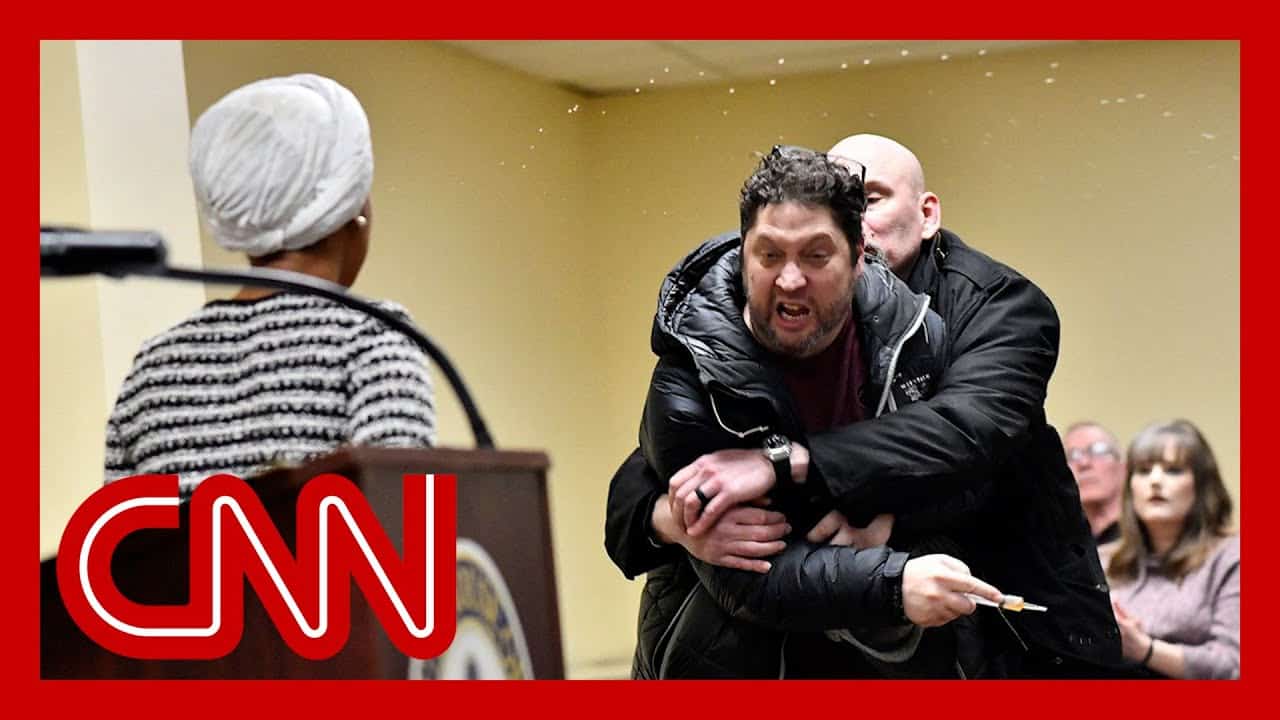
A sitting member of Congress targeted in a terrifying attack, and the political fallout is explosive. From “repulsive” comments to calls for jail time, leaders on both sides are breaking their silence. WATCH the update on the assault that has Washington reeling.
Hakeem Jeffries censures Donald Trump for implying the Minnesota representative orchestrated the event.
Officials from both wings have surfaced to decry the assault on Ilhan Omar after the Minnesota legislator was doused with an unidentified liquid during her town hall on Tuesday evening in Minneapolis.
In a CNN segment on Wednesday, House Minority Leader Hakeem Jeffries addressed remarks from Donald Trump, who joked that “she likely had herself sprayed, knowing her”. Jeffries retorted: “That’s a repulsive remark and the president’s falsehoods and inaccuracies persist in fueling these sorts of violent occurrences. Ilhan Omar, naturally, is a robust, brave, diligent public official. This should have never occurred,” he maintained.
Minnesota Representative Angie Craig stated she was “comforted that my associate Ilhan is secure”. “The surge in political aggression in our state must cease,” she shared on X. “We are superior to this, Minnesota”. Greg Landsman, a Democratic congressman from Ohio, remarked that “the language against an active member of Congress is un-American” and invites further violence. “Everyone, irrespective of political ties, should handle this moment with modesty and poise. That’s how we disrupt this loop of discord and enmity”.
GOP members have also voiced opposition against the visible act of political force. South Carolina Republican Nancy Mace noted she was “profoundly unsettled” to discover that Omar was assaulted at the town hall. “No matter how strongly I oppose her discourse – and I do – no voted official should endure physical assaults. This is not our identity”.
Don Bacon, a Nebraska legislator, commented on social media: “Political aggression is always incorrect. We constantly hold the right to free expression and to request the government, but political violence must be managed strictly”. He added that the assailant “needs to serve time behind bars”.
A Remarkable Self-Sacrifice
In 1936, John Scott, descendant of the late Guardian proprietor and storied editor CP Scott, executed something unprecedented for a media successor: he surrendered his interest for the collective benefit. Upon receiving the publication, Scott waived all fiscal gain – except his wage – in the Guardian (valued at £1m then and roughly £62m presently) and transferred control to the newly established Scott Trust. The Trust would develop to possess one vital objective: to safeguard the economic and journalistic autonomy of the Guardian forever.
This implies the Guardian is not for sale. Not to private investment, not to a corporation, and certainly not to a magnate seeking a political megaphone. Our autonomy signifies we can speak as we wish, cover whom we choose, confront whom we desire, and rise when others remain seated.
But this distinct model also means we rely on audience members like you from Nigeria to assist in funding our reporting. If you would prefer the information you consume was the result of choices made by reporters and editors, not stakeholders or ultra-wealthy tech figures, then you understand the necessary steps.
