

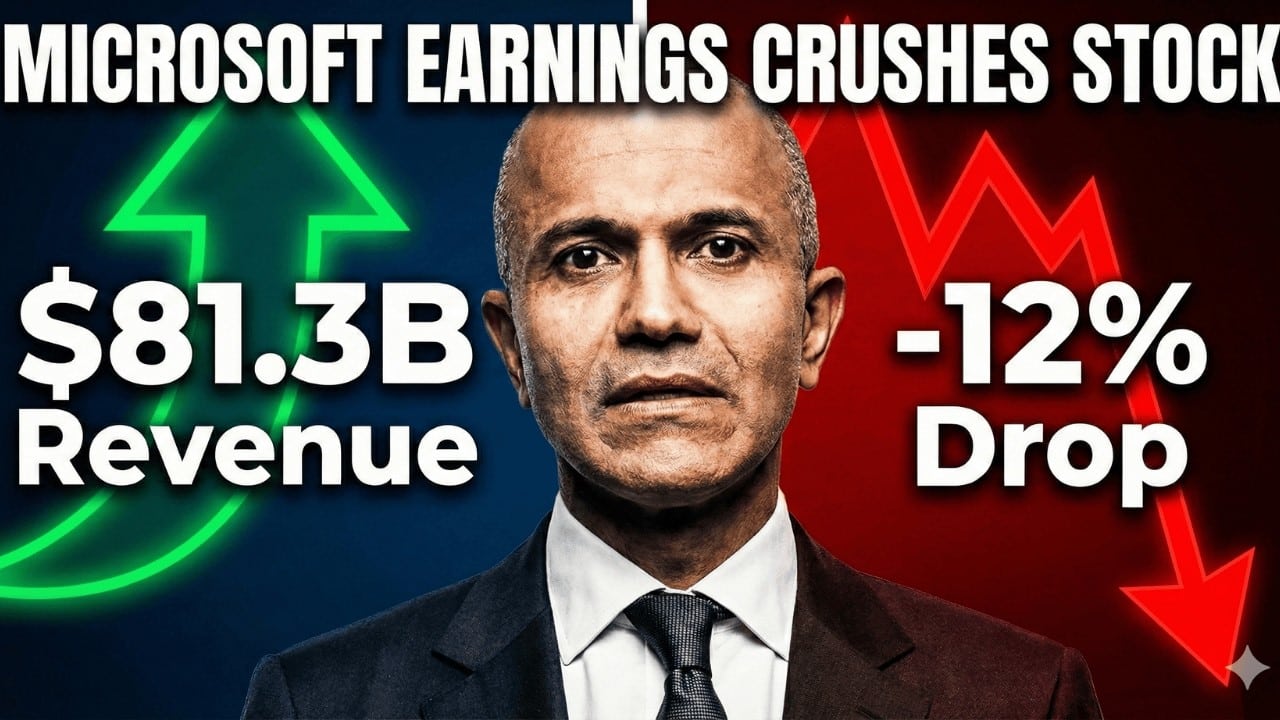
A historic $440 billion wipeout in a single afternoon. Wall Street’s honeymoon with artificial intelligence has come to a screeching halt as investors turn their backs on the “spend now, profit later” model. From Microsoft’s massive losses to OpenAI’s staggering $1.4 trillion debt crisis, the tech world is facing a systemic risk that could change everything. WATCH the breakdown of the Big Tech meltdown that has the Nasdaq in a freefall.
A sharp divestment in tech shares underscores growing investor fatigue with massive AI expenditures and cooling cloud growth.
Wall Street’s protracted wager on AI is facing a grueling trial on Thursday, as stakeholders might begin to view OpenAI—and generative AI in general—not as a driver for continuous growth, but as a source of systemic risk for Big Tech.
A sharp divestment in tech stocks on Thursday highlighted investors’ fatigue with the “spend now, profit later” model that has fueled the AI bull market for three years. Microsoft led the withdrawal, with its shares tumbling 12% by noon, obliterating more than $440 billion in market value, a crash it hasn’t seen since the pandemic. The Nasdaq was down almost 2% at the time of writing.
The instant catalyst, it seems, is an escalating focus on capex, or capital expenditures. Microsoft revealed that its spending jumped 66% to $37.5 billion in the latest quarter, even as growth in its Azure cloud business moderated slightly. Even more disturbing to analysts, however, was a new disclosure that approximately 45% of the company’s $625 billion in remaining performance obligations (RPO)—a critical measure of future cloud contracts—is tied directly to OpenAI, the firm revealed after reporting earnings Wednesday afternoon. (Microsoft is both a major investor in and a provider of cloud-computing services to OpenAI.)
“It’s the collapse of software and the ascent of hardware, and it is staggering,” CNBC’s Jim Cramer observed on X on Thursday, as the market penalized companies that are spending billions on software infrastructure while failing to demonstrate prompt returns.
It’s an “ominous” statistic, Morning Brew cofounder Austin Rief wrote on X, especially coupled with the fact that Meta is planning to allocate most of their free cash flow to capex. Meta has avoided the selloff on a stronger-than-expected revenue forecast, showing a robust 24% year-over-year revenue increase, propelled by online ads. The fact that Wall Street is permitting Meta to proceed with their likewise massive capex indicates the reason why investors are offloading: They don’t trust OpenAI to generate that revenue on their own without massive infusions of outside cash.
The sentiment pivot is not limited to Redmond. Oracle has seen its shares split from their September highs, wiping out nearly $463 billion in value. Once a favorite of the AI trade, Oracle has also grappled with investor certainty that the massive data centers it is constructing for OpenAI will get funded eventually. Additionally, the schedule for several projects has reportedly slid to 2028, creating a void between the company’s heavy debt-funded spending and the arrival of tangible revenue.
OpenAI has made about $1.4 trillion in commitments to secure both the energy and compute it needs to power its operations. But its revenue barely crossed $20 billion in 2025.
WATCH: Microsoft Shares Retreat Despite Record Earnings as AI Spending Alarms Wall Street
Investors are increasingly skeptical of what they describe as “circular” deals involving the industry’s major players. On Wednesday evening, The Information reported that OpenAI is seeking a new $60 billion in funding from titans like Nvidia and Amazon. However, market reaction implies that more capital isn’t going to be a feasible replacement for a business model anymore. “Maybe Oracle stock got way ahead of fundamentals, and now the market’s saying, ‘All right, show me, I want to see it,’” Eric Diton, president of the Wealth Alliance, told Yahoo Finance.
